SIM-only comparison
Sky Mobile vs iD Mobile: Which SIM-Only Deal Is Better?
On this page
At a glance · Coverage · Contract cost · Piggybank and rollover · Roaming · Daily use · Who should choose · Before switching · FAQ
Sky Mobile is the stronger choice when O2 works better where you live, or when you will actually use Sky Piggybank to save and share unused data for months. iD Mobile is more compelling when its Three-based service works well and you value included roaming, one-month rollover or a new SIM-only plan advertised without annual price rises. Neither wins everywhere. Check reception first, then compare the whole contract rather than its opening price.
Compare current Sky Mobile SIM-only deals and iD Mobile plans on DealPriceCheck before deciding. If Sky looks right for you, check the live card’s data allowance and contract length, open Full plan details for the payment schedule, and then use its verified View Deal purchase route. The comparison below also explains when choosing iD instead would be the sensible decision.
Sky Mobile vs iD Mobile at a glance
| What matters | Sky Mobile | iD Mobile |
|---|---|---|
| UK coverage | Uses O2's network | Three-based; phased access to VodafoneThree shared-network improvements |
| Unused data | Eligible spare data enters Piggybank for up to 12 months | Eligible spare data carries to the next month only and is used first |
| Household use | Eligible Piggybank balance shared across up to seven SIMs on one account | Individual plan rollover; no equivalent long-term shared pot |
| SIM-only terms | Rolling 30-day, 12-month and 24-month offers; availability differs by offer | Advertises 30-day, 12-month and 24-month offers |
| Price predictability | Some deals have introductory step-ups and provisions for later changes | Current new SIM-only range advertises no annual price rises; promotional periods may still end |
| Roaming | Paid pass in many destinations, with country and VIP exceptions | Inclusive roaming in qualifying destinations, subject to the plan and fair use |
| 5G | Compatible handset and coverage; free 5G Network add-on needed | Compatible handset and coverage; access depends on area and plan |
| Extras | Piggybank rewards, Sky Watch, Sky Mix | Bill capping, iD Perks and one-month rollover |
The decision in one sentence: choose the network that works, calculate the entire cost, then decide whether you will get more practical value from Sky's longer-term data bank or iD's roaming and pricing arrangements.
Coverage: should you choose O2 or Three?
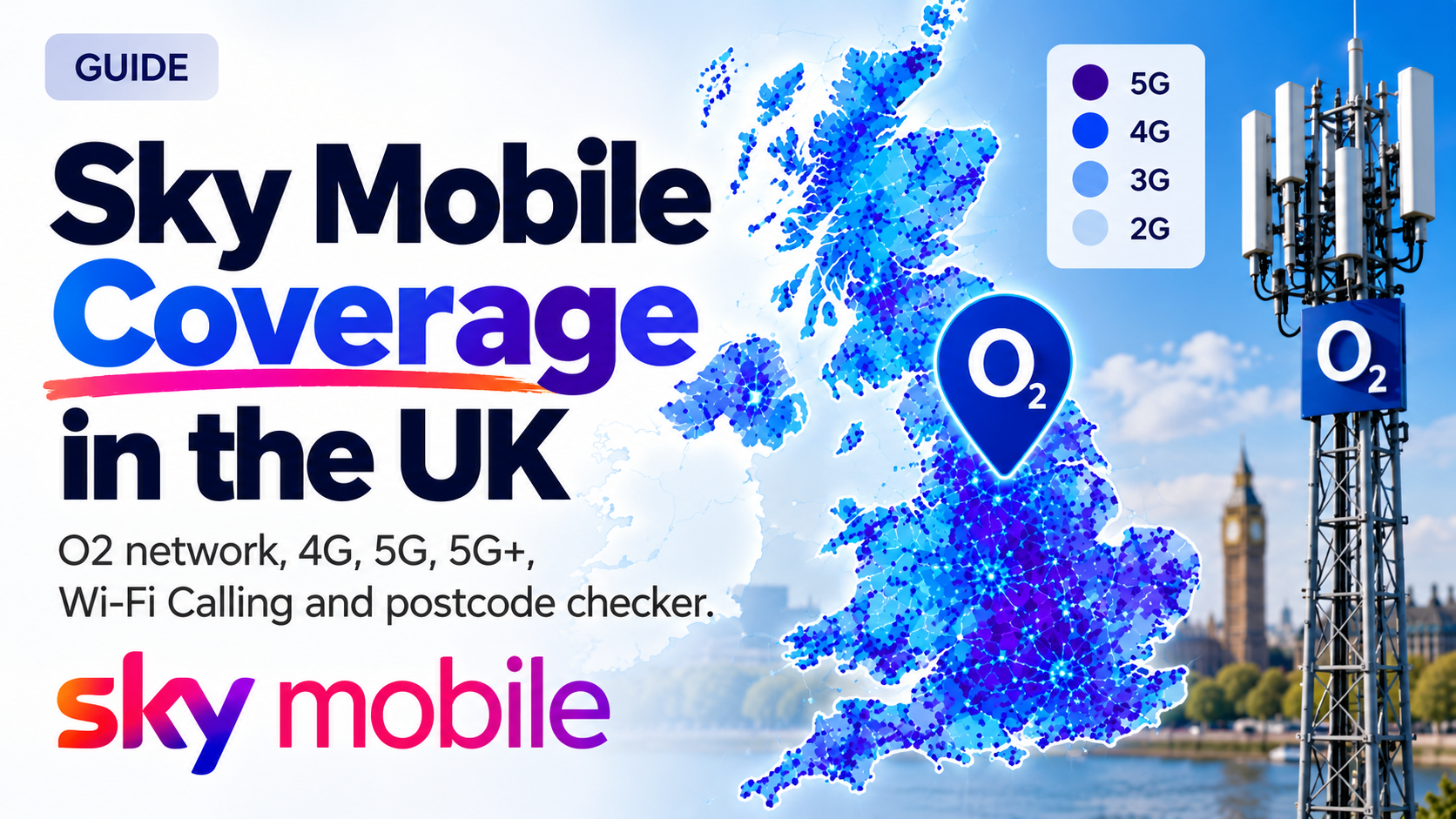
Sky uses O2, whereas iD uses Three-based mobile service. Vodafone and Three merged their UK businesses to form VodafoneThree, and iD describes an ongoing programme giving customers access to upgraded, shared Vodafone and Three infrastructure. This does not mean every iD SIM instantly receives identical coverage on both networks or the same 4G, 5G and 5G+ capabilities at every mast. Availability changes as upgrades are completed. Sky and iD should not be treated as two brands on the same network.
Check Ofcom's Map Your Mobile service for your home (especially indoors), workplace and somewhere you travel regularly. The checker provides predicted coverage and comparative information. It cannot guarantee reception in an individual room or on a moving train, so a recent real-world test with a compatible phone can be more revealing.
| What you find at the places that matter | Practical next step |
|---|---|
| O2 works reliably indoors and Three performs poorly | Prioritise suitable Sky offers |
| Three works better and O2 struggles | Give iD serious consideration; check which local improvements are actually available |
| Both work acceptably | Compare payment schedules, roaming and useful extras |
| Both fail indoors but Wi-Fi is strong | Check your exact phone's Wi-Fi Calling support, and whether you need reliable outdoor service |
| A future network upgrade is the main selling point | Do not enter a long minimum term assuming the upgrade has already reached you |
A past Three coverage test may become outdated as VodafoneThree sites are upgraded. But the opposite mistake is buying on the strength of a nationwide merger announcement rather than service at your address. Our guide to MVNO coverage and speeds explains why access to an underlying network does not establish identical performance. See Sky Mobile's coverage guide for more detail on the O2 side, without turning this comparison into another coverage article.
Is Sky Mobile faster than iD on 5G?
Neither is universally faster. Performance depends on local capacity, signal, the technology in use, your handset and the service available to your account. A 5G logo or a merged-network announcement is not a speed guarantee.
Sky's standard 5G requires a compatible phone, coverage and its free 5G Network add-on. Its newer 5G+ service has additional device and eSIM eligibility requirements, so a phone supporting ordinary 5G should not be assumed to support Sky 5G+. iD advertises 5G on its SIM-only range, subject to a supported phone and local network access. Both support eSIM and Wi-Fi Calling/4G Calling on eligible handsets, subject to provider compatibility rules. In particular, do not assume a phone eSIM product automatically supports a smartwatch or tablet.
If dependable indoor calls matter more than maximum download speed, test calling and Wi-Fi Calling as well as mobile data before switching.
Which is cheaper once you calculate the whole contract?
The only fair price comparison is between plans that give you enough usable data, over a stated period, with their actual payment schedule and commitments included. A first-month discount does not tell you what you will pay in month 13, and a 30-day plan does not carry the same exit risk as a 24-month minimum term.
At the time of this comparison, iD advertises no annual CPI or RPI price rises for its new SIM-only plans. That policy must not be extended to every historic iD handset or service agreement. It also does not prevent a clearly disclosed introductory discount from ending when scheduled. Sky's longer offers can have promotional prices that increase after an initial period and may contain other permitted changes. Check the particular contract summary and payment schedule, not just the price badge.
The 24-month price trap: a worked example
These figures are hypothetical, not current Sky or iD offers. Assume both plans have enough data for the same buyer and neither has an additional, unspecified price change:
| Scheduled charge | Illustrative Sky-style offer | Illustrative iD-style offer |
|---|---|---|
| Months 1–12 | £6 × 12 = £72 | £8 × 12 = £96 |
| Months 13–24 | £10 × 12 = £120 | £8 × 12 = £96 |
| 24-month scheduled total | £192 | £192 |
| Incorrect shortcut | £6 × 24 = £144 | Not applicable |
The Sky-style deal looks £2 cheaper at first, but the planned totals tie. The opening price multiplied by 24 understates that illustrative Sky total by £48. A separate, contractually permitted rise would need to be considered in addition. This is why a deal with a lower headline amount is not necessarily better value.
The 12-month versus 24-month commitment test: use the same hypothetical figures above, but imagine the iD-style £8 plan requires only 12 months, not 24. In the first year, the Sky-style plan costs £72 and iD £96. Sky is £24 cheaper over those 12 months, but the Sky buyer still has another £120 of scheduled payments under the 24-month agreement if they stay. That figure is not a quoted early-termination fee; leaving charges depend on the actual contract. The iD buyer can review the market at the end of their shorter term. If iD were available at the same £8 rate for another 12 months, the illustration would tie again at £192 over 24 months, but that future renewal price is an assumption, not a guarantee. This distinction is more useful than comparing unrelated 12- and 24-month minimum totals.
Before buying, check five numbers: the data you normally use; the opening price; each known later price; the full minimum-term total; and the cost of leaving early. Then add roaming or paid extras you expect to use. If you may need to switch soon, the flexibility of an eligible rolling 30-day tariff can outweigh a modest saving on a long contract.
For the wider tariff category, use our SIM deals with no annual price rises page. Compare current Sky plan cards and full details with the iD Mobile plans in our catalogue, rather than treating the illustration above as a live quote.
Sky Piggybank or iD rollover: which actually helps?
The schemes look similar on a comparison badge, but they solve different problems.
Sky Piggybank: unused data from eligible, fixed-allowance Sky plans is banked after the billing period and can remain for up to 12 months. You can withdraw data in whole 1GB increments for eligible SIMs on the same account, and the shared Piggybank can serve up to seven SIMs. Available rewards may provide another use for spare GB, but a stored gigabyte is not a fixed amount of cash or a guaranteed discount. Data automatically expires at the end of its eligible period. Sky Unlimited does not generate Piggybank data or accept Piggybank top-ups.
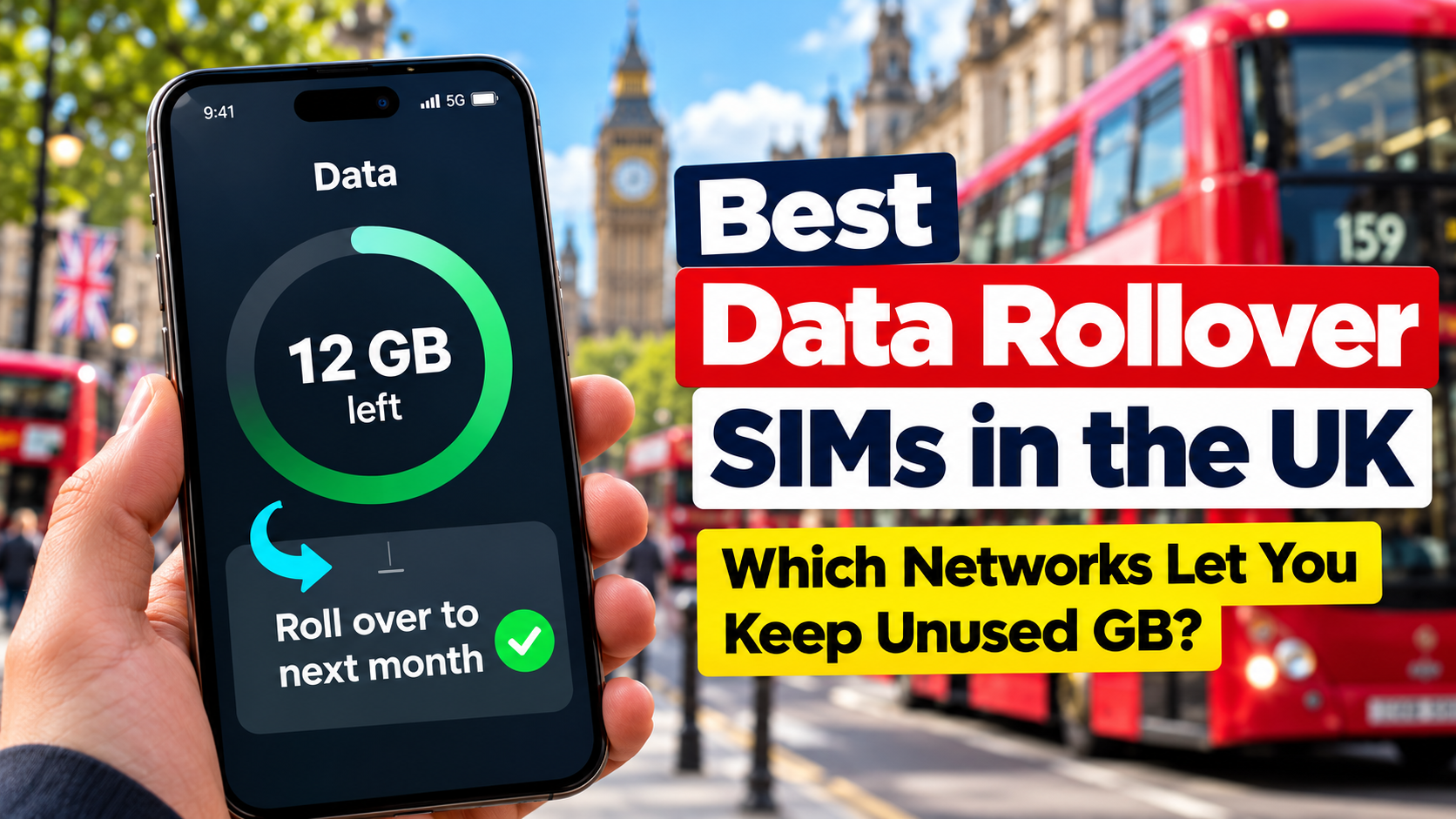
iD Mobile rollover: qualifying unused data moves to the next billing month, where it is used before the fresh monthly allowance. Any unused portion of that older balance expires after that one extra month; it cannot be rolled forward indefinitely. A change of plan can reset a rollover balance. This provides a useful short buffer, not a long-term family reserve.
Example: the expensive month happens much later
Imagine you have 10GB per month and use only 3GB in January, leaving 7GB unused.
- With an eligible Sky plan, the 7GB is moved into Piggybank. Subject to eligibility, its 12-month expiry and any withdrawals in between, it could be available for a much heavier June.
- With an eligible iD plan, the 7GB is available in February and used first. Any January data still unused after February expires. It cannot fund a busy June.
- If every month is predictable and your total usage stays below 10GB, neither data-saving feature automatically justifies paying more. A cheaper allowance closer to what you use could beat both.
Does sharing data make Sky worth a premium?
For a household with several Sky SIMs, a shared bank can prevent old unused data sitting on one line while another line needs a top-up later. However, unused data first has to be banked after a billing period. Piggybank is not an unlimited, instantaneous transfer of this month's active allowance between unrelated accounts.
| Your real usage pattern | The more useful approach |
|---|---|
| Quiet months followed by occasional heavy use several months later | Sky Piggybank, if the price premium is reasonable |
| A light month immediately before a heavy one | iD's next-month rollover may already be enough |
| Several eligible SIMs with uneven usage and a shared account | Sky's collective Piggybank can be worthwhile |
| Heavy usage every month | Buy an appropriate larger or unlimited allowance; there may be little to bank |
| You almost never redeem saved data or rewards | Choose by cost and coverage, not by the size of a rarely used balance |
There is a straightforward value test: if Sky costs £3 more per month, you pay £36 extra over 12 months. Piggybank is worth that difference only if the data or rewards you actually use would otherwise have cost or saved you more than £36, or you value another Sky benefit enough to cover it. This £3 example is hypothetical, not a live tariff comparison.
For a comparison of other rollover schemes, see our best data rollover SIMs guide. This article's narrower question is whether Sky's particular system makes it worth choosing over iD.
Is roaming cheaper on iD Mobile or Sky Mobile?
For a customer who regularly travels within iD's inclusive roaming area, iD will often be the cheaper and simpler choice. Sky may make more sense for certain destinations outside that area or for an existing customer with the right Sky VIP benefit.
Under the providers’ published roaming terms checked on 24 October 2026 (not a promise that destination lists or fees will remain fixed):
- iD Mobile advertises inclusive roaming in 50 destinations. For customers joining or upgrading on or after 21 June 2023, the usual inclusive-roaming data ceiling is 30GB per month or the remaining UK allowance, whichever is smaller. A 5GB UK tariff therefore does not become a 30GB holiday tariff. The Republic of Ireland has a separate exception to the standard 30GB rule. Calls and texts can also vary by roaming band and destination.
- Sky Mobile advertises a wider 120-destination Roaming Passport Plus range, generally £2 for each qualifying 24-hour period of use. A pass is not triggered simply by arriving abroad. Sky's published qualifying actions include making a call, sending a text or using more than 10MB of mobile data, so background activity matters. The relevant data fair-use limit is 25GB per billing cycle, with destination-specific exceptions and separate rules for the Republic of Ireland, Channel Islands and Isle of Man.
- Sky VIP Diamond customers who meet the current eligibility rules can receive free roaming in qualifying Sky destinations. This is not a standard benefit for everyone who has a Sky SIM or Sky TV. Check your own VIP status before counting the saving.
What can roaming do to the annual cost?
Suppose a traveller triggers 14 qualifying Sky pass periods over a year in a destination that also qualifies for iD's inclusive roaming. At the Sky rate reviewed above, the extra Sky cost is 14 × £2 = £28. That is equivalent to about £2.33 per month over a year. Within iD's relevant roaming allowance and fair-use limits, the extra roaming-pass fee could instead be £0.
If a hypothetical Sky plan saves £2 a month on UK line rental, it saves £24 over a year but loses £28 to those pass charges: it ends £4 more expensive, before any other differences. Neither comparison tariff is being quoted as a live deal here. A customer with Sky VIP Diamond eligibility, fewer qualifying pass periods or a different destination could reach the opposite result.
Do not equate a day's holiday with exactly one charge without considering the relevant 24-hour activation windows. Also, a £0 bill/spend cap can prevent chargeable roaming from working: iD's cap can still allow use of included roaming, while Sky's paid pass generally needs sufficient room under the cap. Cruises, ferries, aircraft and destinations outside the included lists may attract different charges. Confirm the country and terms before departure.
For a short UK-only user, roaming may be irrelevant. For someone who spends several weeks abroad every year, it can decide the whole comparison.
What else matters in daily use?
Sky Watch: useful streaming data, not a free TV subscription
Sky Watch allows qualifying streaming through specified Sky apps in the UK without counting eligible viewing data against the normal mobile-data allowance. Downloads are not a general data-free mobile feature; Sky restricts supported downloads to Wi-Fi. You need an active Sky Mobile plan with at least 50MB available. Content rights or subscriptions may still cost money, and some advertising can use mobile data. Netflix, YouTube and other unrelated streaming apps do not become data-free merely because you have a Sky SIM. The benefit does not operate as a free global Sky streaming pass while roaming.
This can be valuable for someone regularly watching eligible Sky content away from Wi-Fi. It is not valuable simply because an operator advertises an entertainment perk.
iD bill capping: more direct control over extra charges
iD lets customers set an adjustable cap on out-of-plan usage, including £0, but the ordinary monthly rental and specified extras or add-ons sit outside that cap. A £0 cap helps reduce unwanted premium or non-inclusive charges, while potentially blocking services that would cost extra, including paid roaming outside an inclusive zone. iD Perks may offer other benefits, but the actual offers and eligibility can change.
Flexibility: mixing a plan is not cancelling a contract
Sky Mix can let eligible customers adjust their data allowance, but a change can affect promotional terms and does not wipe out a minimum-term obligation. iD also has plan-change rules; making a tariff more expensive or changing your allowance is not the same as being free to leave a long contract. If easy exit is a priority, look at the actual rolling product and notice rules, rather than assuming that any plan change means no commitment.
Who should choose Sky Mobile, and who should choose iD?
Choose Sky Mobile if...
- O2 reception is clearly better at the locations where you need your phone.
- Your data use varies across several months and you will genuinely withdraw saved Piggybank GB.
- You have several eligible Sky SIMs on one account that can benefit from a shared bank.
- You use qualifying Sky apps in the UK and understand the 50MB, subscription and advertising restrictions.
- You have confirmed Sky VIP Diamond roaming, or Sky's qualifying destination coverage makes more sense for your trips.
- A specific current Sky offer wins after you include its full payment schedule, any roaming spend and contract commitment.
Compare Sky offers now: visit Sky Mobile SIM-only deals, choose the data and contract length, check Full plan details, then use the existing sponsored View Deal route when the offer fits. If our selected live cards do not include the plan you need, you can also explore Sky's wider mobile plan range using our verified general affiliate link. That link is to Sky's plans range, not a deep link to a particular data allowance.
Choose iD Mobile if...
- Its Three-based service, including any VodafoneThree improvements actually available in your area, gives you better everyday coverage.
- You regularly use its inclusive roaming destinations and would otherwise pay several Sky pass charges.
- You value the currently advertised no-annual-price-rise policy on a qualifying new SIM-only plan, while understanding promotional end dates.
- One-month rollover is sufficient, so you have no reason to pay extra for long-term data banking.
- The iD tariff you can buy has a better like-for-like total with a commitment you accept.
- An adjustable cap on out-of-plan spending is more helpful to you than Sky-specific entertainment benefits.
iD can be the right answer. For more background, you can review the iD Mobile plan information on DealPriceCheck. Do not buy Sky simply to obtain a perk you will never use. If O2 coverage is suitable and Sky remains on your shortlist, compare the actual contract schedule on our Sky Mobile deals page.
Five checks before you switch
- Test O2 and Three where it matters. Use Ofcom's independent map, look at indoor coverage and check any shared-network improvement that is actually operating locally.
- Read your last three or four usage bills. If you average 6GB, an oversized allowance and a big Piggybank headline may not be worth a monthly premium.
- Calculate a like-for-like total. Include every known promotional step-up, allowed increase, roaming fee and paid add-on. Show remaining obligations when the minimum terms are different.
- Check your exact phone. Verify 4G Calling, Wi-Fi Calling, 5G and eSIM compatibility, especially on imported or older devices.
- Keep your number if you wish. Normally you can text PAC to 65075 from your current SIM and give the code to the new provider. Check any early termination or separate handset balance before authorising the move.
For a broader choice beyond these two brands, use our UK SIM-only comparison. This article is specifically about deciding between Sky and iD, not ranking every network in the UK.
Frequently asked questions
Do Sky Mobile and iD Mobile use the same network?
No. Sky runs on O2, while iD is Three-based and is being affected by the phased VodafoneThree network integration. Coverage and available technologies can differ by location, plan and device.
Which provider lets me save unused data for longer?
Sky Piggybank can keep eligible spare data for up to 12 months, with whole-GB withdrawals and sharing on the same account. iD carries qualifying unused data into the next month only and uses it before that month's new allowance.
Does Sky Piggybank work with unlimited data?
No. A Sky Unlimited Data SIM does not contribute spare data to Piggybank and cannot receive Piggybank top-ups. Compare unlimited products on price, network and relevant terms instead.
Does iD Mobile increase SIM-only prices every April?
Its current new SIM-only range advertises no annual CPI or RPI increases. This is not a promise about every legacy account, handset contract or separate add-on, and a clearly disclosed introductory discount can still end as scheduled.
Do I pay Sky's roaming pass just for arriving abroad?
No. In a qualifying destination, its pass is triggered by specified chargeable use, rather than border crossing alone. Calls, texts and mobile-data use can activate it. Check the current destination rules and any VIP exception before travelling.
Does Sky include 5G automatically without any setup?
Sky offers standard 5G at no additional charge, but its published guidance requires the free 5G Network add-on, a compatible handset and local coverage. Sky 5G+ has stricter device and eSIM requirements.
Can I keep my phone number when moving to either network?
Normally yes. Request a PAC from your current network and provide it to the new one. A number transfer does not cancel any valid outstanding minimum-term charge or handset balance.
Verdict: network first, then usable value
Choose Sky when O2 works better or the data you will actually recover from Piggybank, eligible Sky Watch use or a confirmed VIP benefit justifies its full cost. Choose iD when its local network works, included roaming or simpler one-month rollover suits you, and the total payment schedule or shorter commitment is better. If both have usable coverage, compare like-for-like data, the cost over the same months and what you would still owe if you wanted to leave.
DealPriceCheck compares selected UK SIM-only offers and may receive a commission on eligible partner purchases. Plan prices, promotions, roaming terms and coverage can change. Check your final contract summary and local signal before checkout.